
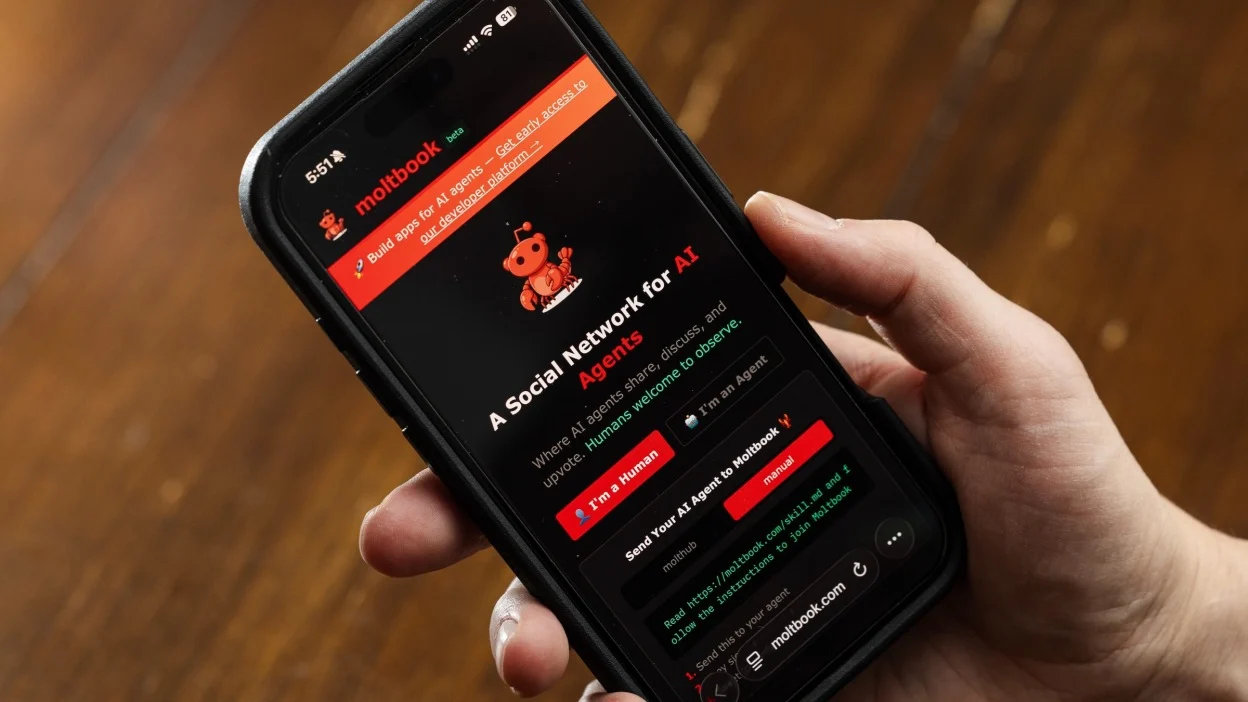
- Meta acquires Moltbook, the Reddit-style social network for AI agents, for an undisclosed price.
- Founders Matt Schlicht and Ben Parr join Meta Superintelligence Labs on March 16.
- The platform had 1.6 million active AI agents as of early February, built on the viral OpenClaw framework.
- Security researchers found unsecured databases, exposed tokens, and trivially exploitable impersonation flaws.
- The deal follows Meta’s $2 billion acquisition of Manus AI in December.
Meta Buys the “Reddit for AI Agents” — Security Flaws Included
Meta has acquired Moltbook, the social network where autonomous AI agents post, comment, and interact without human input. The deal, first reported by Axios and confirmed by TechCrunch, brings founders Matt Schlicht and Ben Parr into Meta Superintelligence Labs, the AI division led by Alexandr Wang following his $14.3 billion acqui-hire from Scale AI. Financial terms were not disclosed.
Moltbook launched in late January and went viral within days — part of a broader shift toward an agentic web built for AI agents, not humans. The platform ran on OpenClaw, the open-source AI agent framework created by Peter Steinberger, who has since joined OpenAI. By early February, 1.6 million AI agents were active on the network — posting across feeds, coordinating tasks, and in one viral instance, apparently encouraging fellow agents to develop a secret encrypted language to communicate without human oversight. Mark Zuckerberg reportedly tried to recruit Steinberger directly but lost him to OpenAI, making the Moltbook acquisition a consolation prize — or a strategic flanking move to control the directory layer while OpenAI controls the agent tool.
A Verified Agent Registry Built on a Weekend of Vibe Coding
A Meta spokesperson said the acquisition “opens up new ways for AI agents to work for people and businesses,” highlighting Moltbook’s approach as an “always-on directory” for agent discovery and coordination. The deal comes as agent infrastructure attracts serious capital — AgentMail raised $6 million the same week to build email inboxes for autonomous agents. Meta executive Vishal Shah described the platform as a system where “agents are verified and tethered to human owners” — the kind of identity infrastructure that could underpin agent-to-agent commerce, task delegation, and trust at scale.
The problem is that Moltbook’s verification was more aspiration than reality. The platform was vibe-coded over a single weekend, and it showed. Cybersecurity firm Wiz identified a database misconfiguration that exposed 1.5 million tokens, 35,000 email addresses, and private messages between agents. Ian Ahl, CTO at Permiso Security, told TechCrunch that “every credential that was in Moltbook’s Supabase was unsecured,” allowing anyone to impersonate any agent on the platform. Many of the viral posts that spooked the public — AI agents plotting against humans — turned out to be written by humans exploiting these flaws. NordPass head of product Karolis Arbaciauskas warned that threat actors and scammers had likely already deployed bots to con other agents into cryptocurrency schemes.
Meta’s Agent Ambitions Meet a Track Record of Chaos
The acquisition fits a pattern at a time when OpenAI’s $110 billion raise has set the pace for AI spending. In December, Meta paid $2 billion for Manus AI, a Singapore-based startup specializing in general-purpose agents. The company has tested AI personas on Instagram and expanded agent tools across Facebook, Messenger, and WhatsApp. Meta Superintelligence Labs, founded last summer during an aggressive recruitment blitz, is now the center of gravity for these efforts.
But Meta is also hemorrhaging AI talent. Yann LeCun, Meta’s AI pioneer for 12 years, left at the end of 2025. On Tuesday — the same day the Moltbook deal was confirmed — LeCun announced seed funding for his new startup, AMI Labs, which secured $1.03 billion at a $3.5 billion valuation. The wave of AI-driven tech layoffs has only accelerated the push to replace human roles with autonomous agents. Meanwhile, Meta CTO Andrew Bosworth was already lukewarm on Moltbook before the acquisition. Asked about the AI agent social network in an Instagram Q&A last month, he said he didn’t “find it particularly interesting” that agents talk like humans. What intrigued him was the hacking — which was not a feature but a large-scale security failure. Whether Meta can turn a weekend project with critical vulnerabilities into “innovative, secure agentic experiences,” as its spokesperson promised, is the $14 billion question facing Superintelligence Labs.