
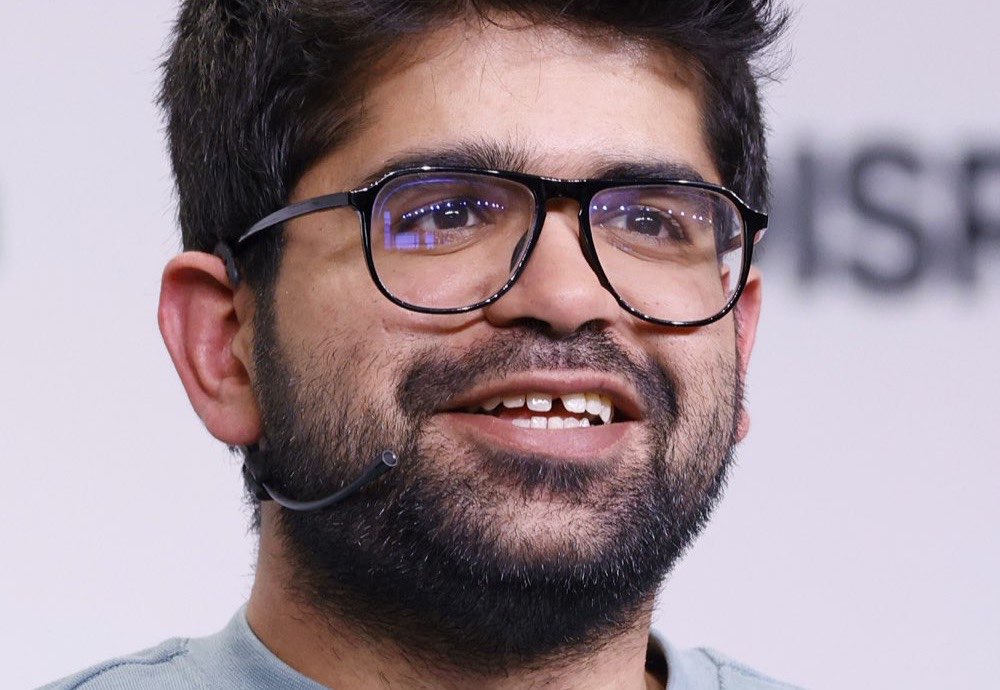
- Perplexity AI has reached a $21 billion valuation with over 45 million monthly active users and $200 million in annual recurring revenue.
- Aravind Srinivas, born in Chennai in 1994, is India’s youngest billionaire with an estimated net worth of $2.5 billion.
- He is one of the few researchers who worked at all three top AI labs: OpenAI, DeepMind, and Google Brain before founding Perplexity in 2022.
- Perplexity launched Comet, an AI-native browser, and bid $34.5 billion to buy Chrome from Google in 2025.
45 Million Users and a $21 Billion Bet Against Google
Perplexity AI processes tens of millions of queries every day. The San Francisco-based company, valued at $21 billion after its Series E round, has grown its annual recurring revenue from $80 million in late 2024 to $200 million by early 2026. Its management is targeting $656 million by the end of the year.
The company’s CEO is a 31-year-old from Chennai who spent his teenage years obsessing over cricket statistics and teaching himself to code. Aravind Srinivas never set out to challenge Google’s search monopoly. He set out to make knowledge accessible — and built a company that does both.
A Bus Ride Past IIT Madras That Changed Everything
Srinivas was born on June 7, 1994, in Chennai, Tamil Nadu, into a family more familiar with finance than technology. His mother had dreamed of attending the Indian Institute of Technology Madras but never got the chance. Every time their city bus passed the IIT campus, she pointed toward the gates and told him, “This is where you are going to study.”
That declaration became a compass. Srinivas excelled in school, winning scholarships and developing an early fascination with systems — how things worked, why they broke, what made them better. Cricket sharpened his analytical instincts. He tracked player statistics the way other kids collected trading cards, building mental models of performance and probability before he knew what machine learning was.
He made it into IIT Madras in 2012, but missed the Computer Science cutoff by 0.01 points. He enrolled in Electrical Engineering instead. At the end of his first semester, he had another chance to switch departments — and missed that threshold by the same razor-thin margin. It was the kind of setback that could have derailed his trajectory. It accelerated it.
From Kaggle Competitions to Three AI Labs
A roommate at IIT introduced Srinivas to Kaggle, the data science competition platform. With no formal coding background, he taught himself machine learning using open-source libraries like Scikit-learn. By the time he graduated with dual degrees in 2017, he had published research and earned a spot in UC Berkeley’s PhD program in Computer Science.
”The best thing you can do for another human being is to help them learn and know more.”
At Berkeley, Srinivas focused on reinforcement learning and transformers. He interned at OpenAI in 2018, contributing fundamental research that fed into the DALL-E 2 image generation system. Between 2020 and 2021, he worked at DeepMind in London, studying deep learning at the lab behind AlphaGo and AlphaFold. After completing his PhD in 2021, he returned to OpenAI as a full-time research scientist. He is one of very few people to have worked at all three of the world’s most influential AI labs — alongside figures like Ilya Sutskever — a credential that gave him rare insight into how large-scale AI systems are built, trained, and deployed.
August 2022: The Frustration That Launched an Answer Engine
The idea for Perplexity was born from a simple frustration: search engines returned lists of links, not answers. Google had the technology to do better — its own research labs had built the transformer architecture — but feared disrupting a $175 billion advertising machine.
Srinivas saw the gap. In July 2022, he connected with Denis Yarats, a former Meta AI researcher whose work closely mirrored his own. They brought in Johnny Ho, an engineer from Quora, and Andy Konwinski, a co-founder of Databricks. The four formally incorporated Perplexity AI in August 2022.
”People still want quick, fast answers. That hasn’t changed. What’s changed is that AI can finally deliver them with evidence.”
They launched the search engine on December 7, 2022 — just weeks after ChatGPT exploded into public consciousness. The timing was deliberate. While the world was captivated by chatbots that made things up, Perplexity offered something different: conversational answers backed by cited sources.
Building the Engine: From Zero to 45 Million Users
Early traction came fast. Perplexity raised a $25.6 million Series A in early 2023, followed by a $73.6 million Series B that valued the company at $520 million. The product hit a nerve with researchers, journalists, and professionals who needed reliable answers without sifting through ten blue links.
By 2024, the company had crossed $63 million in annualized revenue and 15 million monthly users. Sacra estimates revenue reached $148 million by mid-2025 as Perplexity layered on new monetization channels, including a Pro subscription tier at $20 per month and enterprise contracts. Jeff Bezos, Nvidia, and Institutional Venture Partners all joined the cap table.
The product itself evolved rapidly. Perplexity introduced Deep Research, a tool that conducts multi-step investigations across the web. It launched Comet, a Chromium-based AI browser, in July 2025, making it free to download by October. Then came the audacious move: in August 2025, Perplexity bid $34.5 billion to buy Chrome from Google, arguing the acquisition could resolve antitrust litigation. Google declined.
$21 Billion Valuation and the Fight for Search’s Future
Perplexity’s September 2025 round valued the company at $20 billion, with total funding exceeding $1.2 billion across ten rounds from 49 investors. By early 2026, the valuation climbed to $21 billion. Srinivas debuted on the M3M Hurun India Rich List with a net worth of roughly $2.5 billion, making him India’s youngest billionaire at 31. TIME named him one of the 100 Most Influential People in AI in 2024.
The competition is formidable. Google has integrated AI Overviews into its search results. OpenAI launched its own search product. Microsoft’s Copilot is embedded across its enterprise suite. Even Anthropic’s Claude overtook ChatGPT in US app store downloads. But Srinivas has carved out a position that none of them occupy: a pure answer engine that doesn’t serve ads. In February 2026, Perplexity doubled down on that identity by discontinuing its AI-integrated advertising and shifting to a subscription-first model.
From Answer Engine to AI Operating System
Perplexity’s roadmap extends far beyond search. Comet Enterprise, launched in March 2026, positions the company as a direct competitor to Microsoft Copilot and Google Gemini in the enterprise AI assistant market. Early customers include Fortune, AWS, and Bessemer Venture Partners.
”When you build a team, you don’t build a homogenous group where everyone has the same skills. You build a team with diverse strengths. We’re applying that same logic to AI workflows.”
Srinivas has spoken about building an “AI operating system” — a layer between users and the internet that understands context, remembers preferences, and acts on behalf of the user. The Perplexity CEO who founded the company to challenge Google’s dominance in AI-powered search now wants to redefine how humans interact with information itself. The kid who tracked cricket statistics on Chennai bus rides is building the system that tracks everything else.