
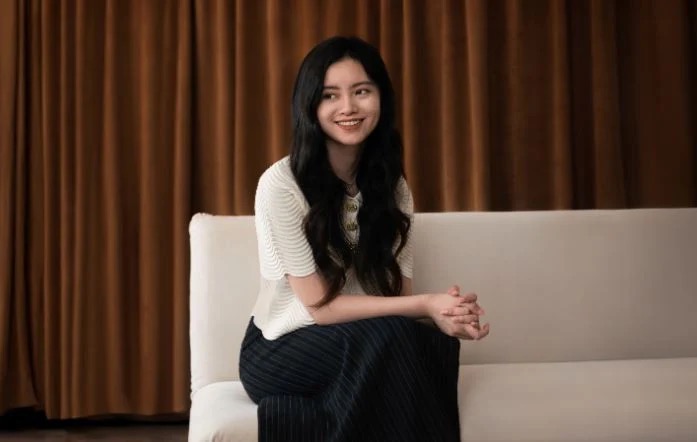
- Pika has raised $135 million at a $470 million valuation, with 16 million users generating AI videos from text prompts across web and mobile.
- Demi Guo won a silver medal at the 2015 International Olympiad in Informatics, graduated from Harvard with degrees in mathematics and computer science, and became the youngest research engineer at Meta AI Research.
- Guo and co-founder Chenlin Meng dropped out of Stanford’s AI PhD program in April 2023 to build Pika, frustrated by the quality of existing AI video tools.
- Forbes 30 Under 30 honoree in 2025, Guo has positioned Pika as the leading consumer AI video platform competing with OpenAI’s Sora and Runway.
Pika sits at the center of a generative AI race that could reshape how the world creates video. The platform counts 16 million users, has facilitated billions of AI-generated clips, and just launched a TikTok-style mobile app that rocketed to the top of both the App Store and Play Store. Its latest model, Pika 2.2, generates 1080p videos up to ten seconds long — a spec sheet that puts it in direct competition with OpenAI’s Sora and Runway.
At the helm is Demi Guo, a 27-year-old Chinese-American founder who went from competitive programming prodigy to CEO of one of Silicon Valley’s most closely watched AI startups. Her path from Hangzhou to Harvard to a Stanford PhD she never finished is a study in impatience — the productive kind.
A Programmer at 10, an Olympiad Medalist at 16
Guo was born in the United States but grew up in Hangzhou, China. Her father, Guo Huaqiang, chaired Sunyard Technology Group, an IT services firm. Her mother graduated from MIT. The household ran on ambition and technical fluency.
She started coding in elementary school. By her third year of middle school, she had won first prize in China’s National Youth Informatics Olympiad. In 2015, representing the United States at the International Olympiad in Informatics in Kazakhstan — a rare case of a U.S. citizen studying abroad in China — she earned a silver medal. She was 16.
That same year, Harvard came calling. Guo enrolled and earned a bachelor’s in mathematics and a master’s in computer science, all while interning at Microsoft, Google, and Facebook AI Research, where she became the youngest research engineer the division had ever hired.
The Youngest Engineer at Meta AI — and the Itch to Build
At Meta AI Research, Guo worked on problems at the frontier of machine learning. The role was prestigious — the kind of position most PhD students spend years chasing. She got it as a college sophomore — joining a generation of researchers who would later leave labs to found companies, much like Dario Amodei’s path from OpenAI to Anthropic.
But research alone wasn’t enough. Guo wanted to build products, not papers. After Harvard, she enrolled in Stanford’s AI PhD program, joining a cohort that included some of the sharpest minds in generative AI. Among them was Chenlin Meng, whose work on denoising diffusion implicit models had become foundational to tools like DALL-E 2, Imagen, and Stable Diffusion.
”We’re not just trying to mimic creativity — we’re trying to augment it.” — Demi Guo
The two became close. They shared a conviction that AI-generated video was about to cross a threshold — and that nobody had built the right tool for it yet.
An AI Film Festival That Changed Everything
The turning point came in the winter of 2022-23. Guo, Meng, and a group of Stanford classmates entered an AI Film Festival organized by Runway. The experience was clarifying — not because the results were impressive, but because they weren’t. The tools were clunky. The output quality was poor. The interface assumed professional expertise.
Guo and Meng knew they could build something better. They had the research background in diffusion models, the engineering skill to ship fast, and the instinct that AI video generation needed to be simple enough for anyone to use. The only thing standing in the way was a PhD neither of them wanted to finish.
In April 2023, they dropped out. Pika was born.
500,000 Users in Six Months and a $55 Million War Chest
The early traction was staggering. Pika launched on Discord first, built a waitlist, and within six months had attracted over 500,000 users. The product was simple: type a prompt, get a video. No editing suite, no timeline, no learning curve.
By November 2023, Pika announced a $55 million raise from Lightspeed Venture Partners, Factorial Capital, and a roster of angel investors. The valuation hit $200 million. Guo was 25, a first-time founder, and already leading one of the most well-funded AI video startups on the planet.
”Most nonprofessionals will never try to create a film using generative AI, but lots of people like to make short videos. It’s really about self-expression.” — Demi Guo
That insight — that AI video was a consumer product, not a Hollywood tool — became Pika’s north star.
$470 Million Valuation and a Race Against OpenAI
In June 2024, Spark Capital led an $80 million Series B that doubled Pika’s valuation to $470 million. The round brought in Greycroft, actor Jared Leto, and Atlantic Records chairman Craig Kallman — a signal that Pika’s ambitions extended well beyond tech circles into entertainment and media.
The competitive landscape had intensified. OpenAI released Sora. Runway kept iterating. But Guo leaned into what made Pika different: speed, simplicity, and a relentless focus on the casual creator. Features like Pikaddition, Pikaswaps, and Pikaffects let users insert characters, swap objects, and apply physics-based effects — tools designed for play, not production pipelines.
By early 2025, Pika 2.2 shipped with 1080p resolution, ten-second video generation, and a keyframe transition system called Pikaframes. Forbes named Guo to its 30 Under 30 list in the AI category.
Pika Becomes a Social Platform — and Tops the App Store
In late 2025, Guo made her boldest move yet. Pika launched a standalone mobile app — part video generator, part social feed — designed to feel more like TikTok than a creative suite. Users generate short AI videos from a few words and share them in a scrollable feed. The app hit number one on both the App Store and Google Play.
A feature called Predictive Video, which anticipates movement and interaction within AI-generated scenes, went viral. Users could insert themselves into generated environments, blurring the line between creator and content.
”We really believe AI will be the next way for people to express themselves and will define the next social platform.” — Demi Guo
The team remains lean — 48 people generating $7.6 million in revenue as of late 2024, a figure that has likely grown significantly with the app launch.
What Comes After the AI Video Boom
Guo is not building a video editor. She is building the infrastructure for a new kind of creative expression — one where the barrier between idea and output is a single sentence. The bet is that AI video generation will follow the same trajectory as smartphone photography: once the tools get easy enough, everyone becomes a creator.
The competition is fierce. Sam Altman’s OpenAI has resources Pika cannot match. Runway has a head start with professional users. But Guo has something neither of them has prioritized: a consumer-first product that treats AI video as a form of self-expression, not a production tool. At 27, with $135 million raised, 16 million users, and a social app climbing the charts, she is not waiting for permission to define the category.