
- HubSpot serves over 228,000 customers in 135+ countries, with annual revenue surpassing $2.6 billion and a market cap north of $30 billion.
- Dharmesh Shah grew up in Ankleshwar, a small town in western India with no paved roads or traffic lights, and switched 18 schools across three countries before landing at MIT.
- Shah bootstrapped Pyramid Digital Solutions with less than $10,000 at age 24 and sold it to SunGard Data Systems in 2005.
- He sold the domain chat.com to OpenAI for over $15.5 million in equity — one of the largest domain transactions in history.
HubSpot powers the marketing, sales, and customer service of more than 228,000 businesses across 135 countries. Revenue crossed $2.6 billion in 2024. The stock trades on the NYSE under HUBS. The platform’s Culture Code — a 128-slide deck written by the CTO — has been viewed over five million times.
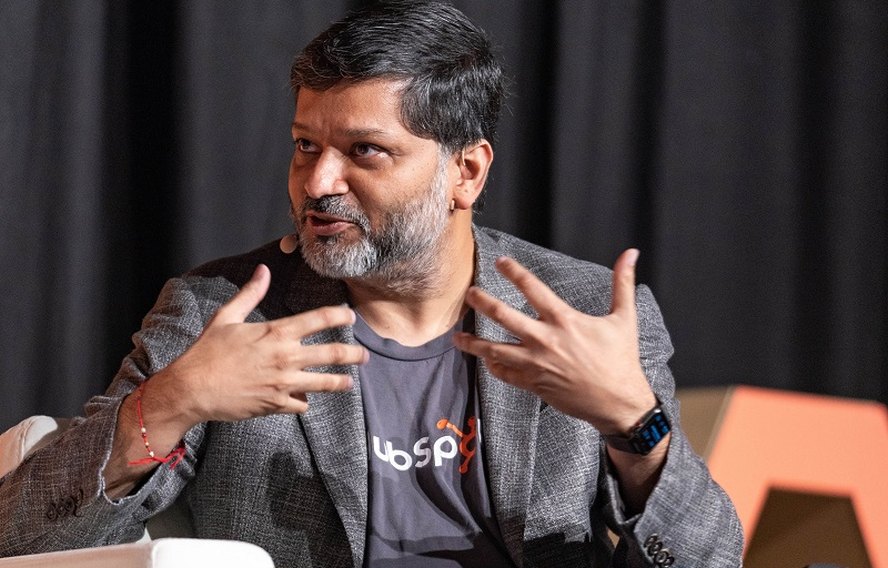
That CTO is Dharmesh Shah, a self-described introvert who codes, blogs, and collects domain names. He has never given a keynote without fighting the urge to flee the stage. He also co-built one of the most influential SaaS companies of the last two decades. This is how.
Born in a Town With No Traffic Lights
Shah was born in 1967 in Ankleshwar, a small industrial town in Gujarat, western India. There were no paved streets, no hospitals. He was delivered at his mother’s family house with the help of a midwife. The home had no television and no hot running water.
His father left for the United States on a student visa while Shah and his mother stayed behind. The family eventually reunited, but the constant moving never stopped. Over 20 years of education, Shah switched 18 schools across India, the United States, and Canada.
”On the extravert to introvert scale, I’m squarely on the introvert side. I’ve had to learn to work with it, not against it.” — Dharmesh Shah
He was, by his own account, a very quiet kid. The kind who observed more than he spoke. The kind who found computers more predictable — and more comforting — than people.
24 Years Old, Less Than $10,000, and a Company That Sold for Millions
Shah earned a computer science degree from the University of Alabama in Birmingham and landed a job at SunGard Data Systems, a financial technology firm. The work was steady. It was also where he spotted the gap.
Financial services companies needed better software tools, and nobody was building them fast enough. In 1994, at 24, Shah left to start Pyramid Digital Solutions — bootstrapped with less than $10,000. The company built reporting and analytics software for the financial services industry.
He ran it for over a decade. No venture capital. No co-founder. By the time SunGard — his former employer — acquired Pyramid Digital Solutions in 2005, Shah had built a profitable, multimillion-dollar business from nothing.
He promised his wife he was done with startups. That promise lasted about a year.
MIT, Brian Halligan, and the Idea That Changed Marketing
Shah enrolled at MIT Sloan School of Management for a master’s in the Management of Technology. The plan was to learn, not to launch. Then he met Brian Halligan.
Halligan had spent years in sales and saw the same thing Shah saw from the engineering side: traditional marketing — cold calls, TV ads, email blasts — was broken. Consumers had learned to ignore it. The companies that were growing were the ones creating content people actually wanted to find.
They coined a term for it: inbound marketing. The idea was radical for 2006 — attract customers through blogs, search engines, and social media instead of interrupting them with ads. In June 2006, Shah and Halligan launched HubSpot out of Cambridge, Massachusetts.
”To really win in the modern age, you must solve for humans.” — Dharmesh Shah
Shah put $500,000 of his own money into the company. He became CTO. Halligan became CEO. The division of labor was clean from day one.
From Blog Posts to Billion-Dollar IPO
HubSpot’s early growth was a live proof of concept for its own thesis. Shah launched OnStartups.com, a blog about entrepreneurship that attracted hundreds of thousands of readers — and funneled many of them into HubSpot’s product. The company was eating its own cooking.
By 2010, HubSpot had thousands of customers and millions in revenue. Shah and Halligan co-authored the book Inbound Marketing: Get Found Using Google, Social Media and Blogs, which became a bestseller and cemented the term in the marketing lexicon.
On October 9, 2014, HubSpot went public on the New York Stock Exchange. The IPO priced at $25 per share, raising $125 million and valuing the company at $1.28 billion. The stock jumped 60% on day one.
Culture Code, 100+ Angel Deals, and a $15 Million Domain Flip
In 2013, Shah published HubSpot’s Culture Code — a 128-slide deck outlining the company’s values, decision-making philosophy, and commitment to transparency. It was not a corporate memo. It was a manifesto, written in plain language, shared publicly. Over five million people read it.
Outside HubSpot, Shah became one of the most active angel investors in the Boston tech scene — and beyond. He has backed over 100 startups, including early bets on Coinbase, Gusto, and Okta. His rule: no founder meetings, no formal due diligence. He bets on products and people he already knows.
Then came the domains. In 2023, Shah quietly purchased chat.com. In November 2024, he sold it to OpenAI for over $15.5 million — paid in equity, not cash. He later sold os.ai to Aravind Srinivas’s Perplexity through another equity swap. For a coder from Ankleshwar, the domain game turned out to be a lucrative side quest.
What Comes Next for the Quietest CTO in Tech
”Success is making those who believed in you look brilliant.” — Dharmesh Shah
HubSpot now employs over 8,000 people. In 2025, the company launched Breeze AI — a suite of AI-powered agents embedded across its CRM platform — and acquired XFunnel, an Israeli startup building tools for AI search optimization. Revenue is trending toward $3 billion. The customer base keeps climbing past 268,000.
Shah, at 58, shows no signs of slowing down. He still writes code. He still publishes on LinkedIn and X. He still avoids the phone. The introvert who switched 18 schools before he was 20 has spent the last two decades proving that you do not need to be the loudest voice in the room to build something that lasts.