
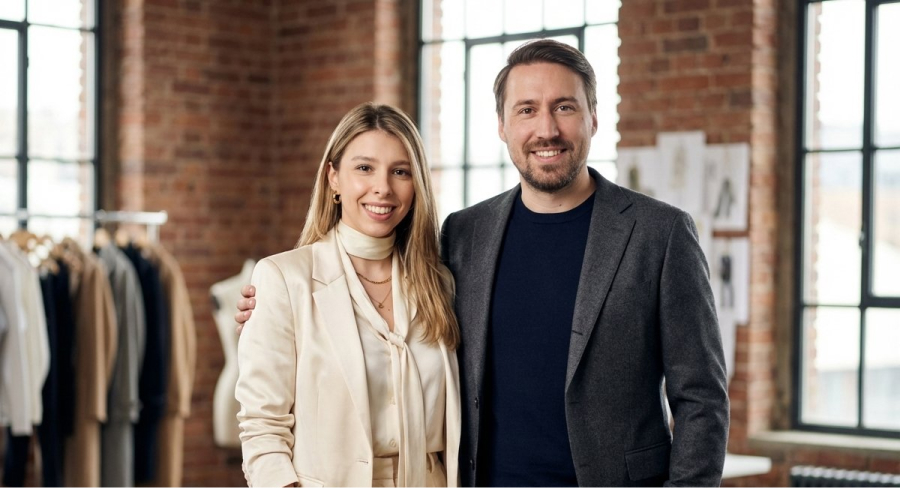
- Aya Bochman and Dan Bochman are childhood friends from Tel Aviv who married at 22 and 24, and now run FASHN AI from Belgrade.
- FASHN AI is 100% bootstrapped, profitable, and growing at 20% month-over-month with a team of four.
- Their proprietary AI models let fashion brands create product images, virtual try-on experiences, and photoshoots without a studio.
- The global virtual try-on market is projected to reach $38.92 billion by 2030, with Zara already onboard and Google entering the space.
- A mobile app is next — a first-of-its-kind tool for brands to create content and product images on the go.
From Tel Aviv to Belgrade, Via a Living Room
Aya Bochman and Dan Bochman grew up on the same street near Tel Aviv, both children of Soviet immigrants who arrived in Israel in the 1980s. After high school, both served as military medics. Dan studied chemistry and engineering. Aya was about to pursue a degree too — until Dan’s father, Alexander Bochman, a pioneering researcher in causal AI, told her to skip university and teach herself to code instead.
They married young — Aya at 22, Dan at 24. When the pandemic hit, they moved to Belgrade, where the cost of living was low and the timezone bridged U.S. and Asian markets. Both took tech jobs. They coded side by side in their living room. They still do.
“Our tech jobs had started to feel stale, and we had two options: either climb the ladder and take bigger roles, or try to build something on our own,” Aya told Ceowire. “We were in our late twenties and early thirties, without kids, and decided that if we didn’t try now, it might never happen later.”
They took a leap of faith with savings from their tech jobs and funded themselves. Ever since COVID, they were used to working next to each other. Doing something like this together just made sense.
Fashion Had a Billion-Dollar Blind Spot
It was Dan Bochman who said they should quit their jobs and build something. Aya Bochman prefers stability — but they agreed it was now or never. They scanned dozens of industries for sectors AI hadn’t touched yet — not the developer tools market where Cursor was already dominant, but something untapped. Fashion was the obvious answer: an industry worth trillions where brands still relied on expensive photoshoots, and online shopping still meant a photo of a model, a size chart, and guesswork. The question was simple — could AI replace fashion photoshoots entirely?
FASHN AI is a virtual try-on AI platform that lets brands and creative agencies create product images with AI, generate consistent AI fashion models, and offer virtual try-on experiences for ecommerce — all without a studio. The Bochmans built their own vision model from scratch — pre-trained on 18 million try-on examples — specialized in fabric texture and fit across different body types. No fine-tuned Flux, no shortcuts. Dan Bochman runs the model as CTO. Aya Bochman runs everything else as CEO — marketing, UX, product.
The moment they knew it was working came in September 2024. “The first version of our virtual try-on model finally started to produce results,” Aya said. “This came after about a year of failure and uncertainty. At the time, we were the first to have something at that level available for commercial use.”
From Two to Four — and Still No VC
The Bochmans pitched investors and accelerators. Every one said no — a far cry from the billions flowing to companies like OpenAI. They wondered if being based in Belgrade instead of San Francisco was scaring off VCs. Friends in tech told them to stop trying. Stay bootstrapped. Keep the equity.
The bet paid off — echoing the same bootstrap-first philosophy that built Sam Parr’s Hustle empire. As a bootstrapped AI startup, FASHN had to grow without a marketing budget — but the product spoke for itself. Pieter Levels, the indie hacker behind Nomad List and PhotoAI, publicly called FASHN the best virtual try-on tool for fashion brands he’d seen in 12 months — sending a wave of traffic and credibility their way. The team has since grown from two to four, the company is profitable, and growth is running at 20% month-over-month. On X, Aya has set a public target: $1 million ARR.
“In the beginning, the biggest challenge was not having the resources to invest much into ads,” Aya said. “Our growth has been purely organic since we started, until recently.”
One surprise along the way: customers started using FASHN to try clothes on cartoon and gaming characters. “It was amazing to see that it worked quite well, even when the person wasn’t real,” Aya said.
Google Is Entering. Zara Is Already In.
The global virtual try-on market is projected to hit $38.92 billion by 2030, growing at 26.3% annually. Google — whose CEO Sundar Pichai just landed a $692 million pay package — has launched its own virtual try-on tools. Zalando is building a 3D avatar-based fitting room. The giants are circling — and Aya Bochman is not worried.
“Zalando’s approach is slightly different from what we’re focused on. Their solution lets shoppers create a digital avatar from body measurements,” Aya explained. “With Google’s launch, we decided to embrace it. In some parts we’re even using their models, which are great. If anything, Google’s entry helped us advance and improve our app further.”
The real moat, she argues, is focus. “FASHN’s main focus is the customer experience — making the best possible tools available so brands can create fashion photoshoots on their own, without the hassle of figuring out which tool works best for this use case.”
Zara is already onboard. Others are following. For brands still hesitant, Aya Bochman has a simple pitch: “The technology produces such realistic results that it has become a no-brainer for many brands. The most important thing to realize is that try-on is first and foremost an experience. It’s not a replacement for real-life sizing. The idea is to let your brand’s customers have fun and experiment with colors or textures without having to walk into a store.”
The Mobile App and the $1 Million Target
The next milestone is a virtual try-on app for ecommerce — a first-of-its-kind mobile tool that will give brands and users a new way to create content and product images directly from their phones. Beyond that, the ambition is to become the one AI fashion model generator and content platform for brands of all sizes, reducing the need for traditional photoshoots entirely.
While debates rage over whether AI will eliminate jobs, the Bochmans are proving it can also create them. No funding, no office, no permission needed — a path more founders from hacker residencies in Da Nang are also choosing. Just Aya Bochman and Dan Bochman, betting on themselves from a living room in Belgrade — and a market that is proving them right every month.