
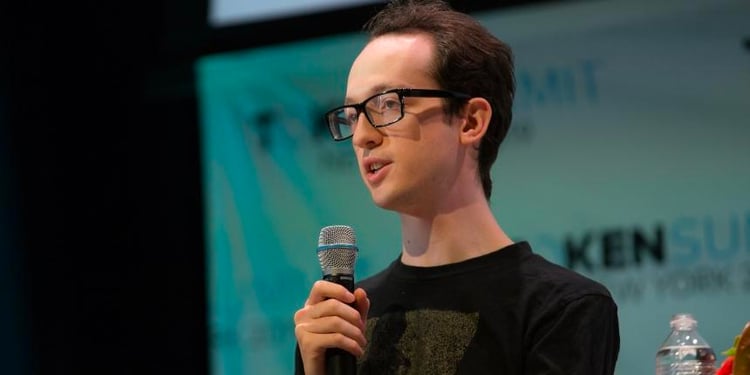
- Uniswap has processed over $3 trillion in cumulative trading volume since 2018, operates across 13+ blockchain networks, and commands 50-65% of all weekly DEX volume.
- Hayden Adams was laid off from Siemens as a mechanical engineer in 2017, learned to code at his parents’ house, and launched Uniswap with a $65,000 Ethereum Foundation grant.
- The SEC issued Uniswap Labs a Wells notice in April 2024, then closed the investigation in February 2025 without enforcement action.
- In 2025-2026, Uniswap launched Unichain, its own Layer-2 network, and introduced v4 with customizable hooks that cut gas costs by up to 99.99%.
$3 Trillion in Trades, Zero Order Books
Uniswap is the largest decentralized exchange in the world. Since launching in November 2018, the protocol has facilitated over $3 trillion in trading volume — all without a single order book, a single intermediary, or a single permission gate. On any given day, $1 billion to $3 billion flows through its liquidity pools across Ethereum, Polygon, Arbitrum, and ten other chains. In 2026, Uniswap commands between 50% and 65% of all weekly decentralized exchange volume globally.
The man behind it never planned to work in finance. Hayden Adams, 30, studied mechanical engineering at Stony Brook University on Long Island and graduated in 2016 expecting a career designing turbines or heat exchangers. Instead, he got fired, learned to code, and built the protocol that made traditional crypto exchanges look obsolete.
A Mechanical Engineer Who Never Fit the Mold
Adams grew up in the suburbs of New York, the kind of kid who liked math but never imagined himself in tech. He enrolled at Stony Brook University for mechanical engineering — a practical degree, a safe career path. He graduated in 2016, landed a job at Siemens running heat flow simulations, and settled into the life of a corporate engineer.
It lasted about a year. Adams was laid off in 2017. The work had never excited him, and losing the job forced him to confront a question he had been avoiding: what did he actually want to build?
”I was mass applying to jobs, kind of lost after getting laid off. Then my friend called me and told me about Ethereum, and it changed everything.” — Hayden Adams
That friend was Karl Floersch, his college roommate, who now worked at the Ethereum Foundation. Floersch had been talking about blockchain for years. Adams had ignored him. Now, unemployed and directionless, he finally listened.
A Three-Hour Phone Call That Rewired Everything
The call with Floersch lasted three hours. Floersch described Ethereum not as a cryptocurrency but as a programmable financial system — smart contracts that could automate trades, loans, and payments without banks. Adams was skeptical but intrigued. He bought some ETH and started teaching himself JavaScript and Solidity from his parents’ house.
Around the same time, Vitalik Buterin had published blog posts describing a theoretical concept: an automated market maker, a system where traders would swap tokens against liquidity pools governed by a mathematical formula instead of matching buy and sell orders. The idea existed on paper. Nobody had built it.
Adams decided to try. Floersch gave him a deadline: build a working prototype with a user interface in one month, and he would demo it at Devcon, Ethereum’s flagship developer conference. Adams built it in time.
$65,000, a Snuck-In Conference Badge, and a Meeting With Vitalik
In January 2018, Adams flew to Seoul for the Deconomy crypto conference. He did not have a ticket. He snuck in, got caught, and was escorted out. But he ran into Floersch in the hallway, who introduced him to Buterin. Adams showed Ethereum’s co-founder his smart contracts. Buterin was impressed enough to suggest he apply for an Ethereum Foundation grant.
”Getting that grant was a turning point. It wasn’t a lot of money, but it meant someone believed in the idea enough to fund it. That gave me the confidence to go all in.” — Hayden Adams
The Ethereum Foundation awarded Adams $65,000. He used it to audit the smart contracts, build a production-ready interface, and prepare for mainnet launch. On November 2, 2018, Uniswap v1 went live. It had $30,000 in liquidity. No VC money. No marketing budget. No team — just Adams, alone, deploying code.
DeFi Summer and the Protocol That Ate Crypto Trading
For over a year, Uniswap stayed small. Then came DeFi Summer in 2020, a boom that also lifted protocols like Anatoly Yakovenko’s Solana. The protocol exploded. Traders poured billions into liquidity pools. Daily volume surged past $1 billion. Uniswap v2 launched in May 2020 with support for any ERC-20 token pair. In September 2020, the protocol airdropped the UNI governance token to every wallet that had ever used the platform — 400 tokens each, worth about $1,200 at the time.
Uniswap v3 followed in May 2021, introducing concentrated liquidity that let providers allocate capital within specific price ranges. Efficiency improved by up to 4,000x. By then, Adams had raised venture funding from Andreessen Horowitz and Paradigm, and Uniswap Labs had grown from a one-man operation into a company with over 100 employees.
The SEC Came Knocking — Then Walked Away
In April 2024, the SEC issued Uniswap Labs a Wells notice — a formal warning that enforcement action was likely. The agency claimed the protocol operated as an unregistered securities exchange. Adams fought back publicly, publishing a detailed legal response and rallying the DeFi community behind the case.
In February 2025, the SEC closed its investigation without taking action. Adams called it “a win for DeFi.” That same month, Uniswap launched Unichain, its own Layer-2 network optimized for trading and liquidity creation. Uniswap v4 had already shipped in January 2025, introducing customizable “hooks” — modular smart contract logic that developers can attach to liquidity pools.
”AMMs are only just getting started. Lower capital costs and composability give them an edge that traditional exchanges simply can’t replicate.” — Hayden Adams
What Comes After $3 Trillion
In 2026, Uniswap is no longer just a protocol. It is an ecosystem. Unichain now processes nearly 50% of all v4 transaction volume. The UNIfication governance upgrade activated protocol fees and introduced UNI token burns — turning what was once a pure governance token into a value-accruing asset. Adams partnered with Securitize to connect BlackRock’s tokenized money market fund BUIDL to UniswapX, bridging DeFi and institutional finance — the same kind of institutional on-ramp that Brian Armstrong’s Coinbase has been building on the centralized side.
Adams still posts regularly on X, still argues about AMM design in threads, still ships. Seven years after deploying $30,000 in liquidity from his parents’ house, Hayden Adams runs the largest decentralized trading protocol ever built — and he is betting that what Uniswap has done to crypto exchanges, it can do to the entire financial system.