
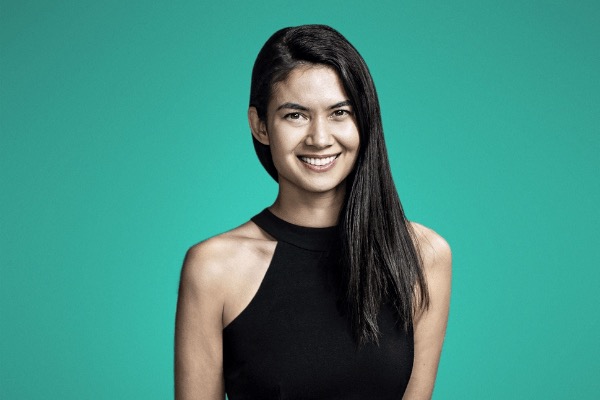
- Canva serves 265 million monthly active users and generates $4 billion in annual revenue, making it the most valuable startup ever founded and led by a woman.
- Melanie Perkins pitched over 100 investors before raising Canva’s first round in 2012, after years of building her first startup from a university dorm in Perth.
- Perkins and co-founder Cliff Obrecht signed the Giving Pledge in 2021, committing over 80% of their equity to the Canva Foundation for philanthropic causes.
- Canva’s largest investor, Blackbird, has told LPs the company is ready for a second-half 2026 IPO at a projected valuation of $75 billion or more.
Canva processed more than 18 billion designs in 2025. Over 265 million people in 190 countries use it every month — from students making presentations to Fortune 500 teams running entire brand operations. The platform hit $4 billion in annual revenue, counts 31 million paid subscribers, and holds a $42 billion valuation that makes it the most valuable female-founded startup in history.
The person behind it is Melanie Perkins, a 38-year-old Australian who spent years hearing “no” from every venture capitalist in Silicon Valley before building one of the most consequential design tools of the last decade. Her journey from outsider to icon parallels that of Dylan Field at Figma — another designer-founder who bet that creative tools could be radically democratized. Her story is not one of overnight success — it is a decade-long grind that began in a Perth bedroom.
A Teenager in Perth Who Sold Scarves Before She Sold Software
Perkins was born in 1987 in Perth, Western Australia. Her mother was a teacher. Her father, a Malaysian-born engineer of Filipino and Sri Lankan descent, had moved the family to Australia before she was born. Growing up in the quiet northern suburb of Sorrento, she trained seriously in figure skating and started a small business selling handmade scarves while still in high school at Sacred Heart College.
After graduating, she enrolled at the University of Western Australia, studying communications, psychology, and commerce. It was there, while tutoring other students in graphic design, that she noticed something that would shape her entire career: everyone struggled with the tools. InDesign and Photoshop were powerful but impenetrable for non-designers.
Fusion Books: A Yearbook Startup That Proved the Concept
In 2007, at 19, Perkins and her boyfriend Cliff Obrecht launched Fusion Books — an online platform that let high school students design and order their own yearbooks using drag-and-drop templates. No Photoshop required. No design degree necessary.
The idea was modest in scope but radical in philosophy: design tools should be accessible to everyone, not just professionals. Fusion Books grew steadily across Australia, expanded into New Zealand and France, and became profitable. It was, as Perkins later called it, the “practice round” for something much bigger.
”I realized the same frustration I saw in my design students existed everywhere. People needed to create, but the tools were built for experts.” — Melanie Perkins
Over 100 Investors Said No — She Kept Flying to San Francisco
Starting in 2010, Perkins began pitching a broader vision: a platform that could democratize all of graphic design, not just yearbooks. The problem was that she was a 22-year-old from Perth with no Silicon Valley connections, no technical co-founder, and a concept most VCs couldn’t wrap their heads around.
She flew to San Francisco repeatedly, crashed on her brother’s floor for months, and pitched over 100 venture capitalists. Every single one said no. The rejections were relentless — too early, too niche, too far from the Valley.
The break came through an unlikely channel. Legendary investor Bill Tai was visiting Perth for a kitesurfing trip. Perkins — who had never kitesurfed — learned the sport specifically to get access to Tai’s MaiTai retreats, where investors and founders mingled between sessions on the water. Through Tai, she met Google Maps co-creator Lars Rasmussen, who introduced her to former Google designer Cameron Adams.
2012: Three Co-Founders, One Mission, and Finally a Check
Adams joined Perkins and Obrecht as Canva’s third co-founder and chief product officer in 2012. His technical credibility was the missing piece that made investors pay attention. Canva raised $3 million in seed funding — its first real capital after years of rejection.
”We had this wildly optimistic belief that design could be as simple as dragging and dropping. Most people thought we were crazy.” — Melanie Perkins
Canva launched publicly in August 2013. Within a year, it had more than 750,000 users. The drag-and-drop interface, pre-built templates, and freemium model hit a nerve that Adobe had ignored for decades. Non-designers could suddenly create professional-looking graphics in minutes.
From Startup to $42 Billion: The Growth That Silenced Every Skeptic
The numbers tell the rest of the story. Canva crossed 10 million users in 2017, 60 million in 2020, and 200 million in 2024. Revenue grew from $500 million in 2021 to $2.5 billion in 2024 and $4 billion by late 2025. The company became profitable and has stayed that way — a rarity among tech companies at this scale, and one that makes Canva’s trajectory stand out on the Forbes billionaires list.
In August 2025, an employee share sale led by Fidelity and JPMorgan valued Canva at $42 billion, minting hundreds of employee millionaires overnight. The company hired former Zoom CFO Kelly Steckelberg in late 2024, a move widely interpreted as preparation for a public listing.
AI has become central to the platform. Canva’s AI-powered tools — including Magic Design, text-to-image generation, and an app builder — now count over 10 million monthly active users on their own. Canva is also a native integration inside ChatGPT, bringing its design engine into conversational AI workflows. The bet on AI-powered design is paying off in both engagement and enterprise adoption.
80% of a Fortune Pledged Away Before the IPO Even Happens
In 2021, Perkins and Obrecht joined the Giving Pledge, committing over 80% of their combined equity — worth billions — to the Canva Foundation. Their combined net worth stands at roughly $11.6 billion according to Forbes, yet they have consistently signaled that the money is not the point.
”We have this wildly optimistic belief that there is enough money, goodwill, and good intentions in the world to solve most of the world’s problems.” — Melanie Perkins
The foundation focuses on education, poverty alleviation, and empowering nonprofits with free access to Canva’s tools. It is one of the largest philanthropic commitments ever made by founders before taking their company public.
The IPO Everyone Is Watching — and What Comes After
Canva’s largest venture backer, Blackbird, has told its limited partners that the company is ready for an IPO in the second half of 2026. Analysts project a public market valuation between $75 billion and $200 billion — which would make it one of the largest tech IPOs in history and the biggest ever out of Australia.
Perkins has said little publicly about timing. What she has made clear is that Canva’s ambition extends far beyond templates and social media posts. The company is pushing deep into enterprise workflows, competing directly with Microsoft and Google on presentations, whiteboards, and internal communications. With 31 million paying customers and a product that keeps expanding, the question is no longer whether Canva can compete with the incumbents — it is how much market share it will take.
From a teenager selling scarves in Perth to the CEO of a $42 billion company that 265 million people use every month, Perkins built Canva the hard way: one rejection at a time, one user at a time, one feature at a time. The IPO will be the next chapter. It will not be the last.