
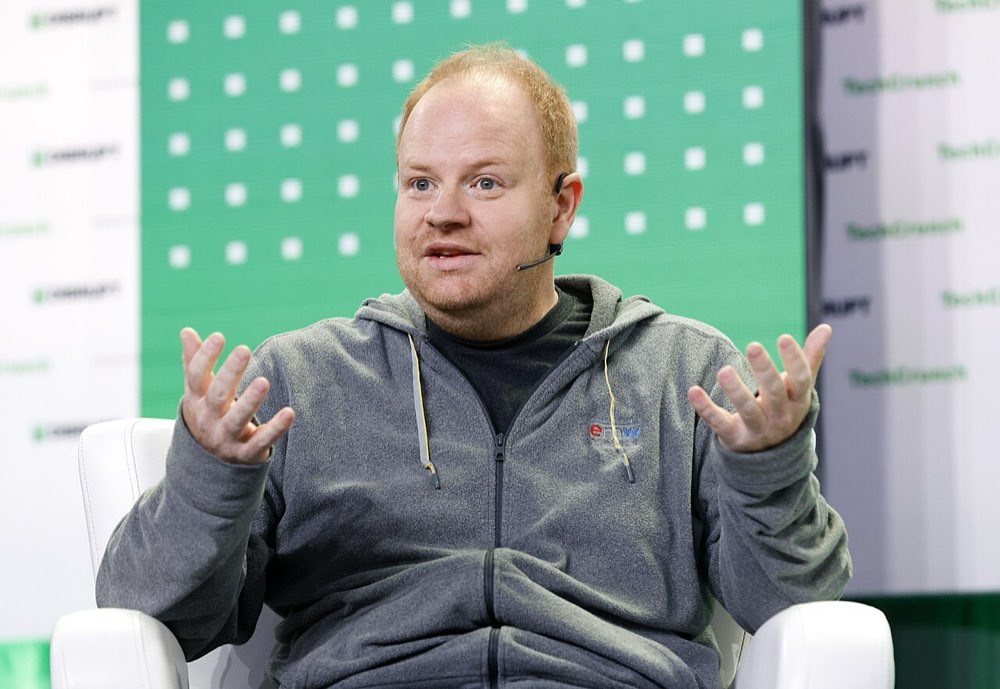
- Rippling is valued at $16.8 billion after raising $1.85 billion total, with $570 million in annualized revenue and over 20,000 customers worldwide.
- Parker Conrad was forced to resign as CEO of Zenefits in February 2016 after a compliance scandal involving unlicensed insurance brokers.
- Conrad co-founded Rippling just six weeks after leaving Zenefits, building the company in stealth for two years from his San Francisco home with co-founder Prasanna Sankar.
- Rippling pioneered the “compound startup” model — building HR, IT, payroll, and finance products in parallel on a single platform, defying conventional startup wisdom.
$16.8 Billion, 20,000 Customers, and a CEO Who Still Runs Payroll
Rippling manages HR, IT, payroll, benefits, expenses, and finance for more than 20,000 companies. Its annualized revenue hit $570 million in early 2025, up from $350 million a year earlier. The company has built over ten product lines, each generating more than $1 million in annual recurring revenue — and new products typically cross that threshold within six months of launch. In May 2025, Rippling closed a $450 million Series G at a $16.8 billion valuation, with backers including Goldman Sachs, GIC, and Sands Capital.
Behind this machine is Parker Conrad, a founder who still approves every expense report over $10 and personally runs payroll. His 14% stake is worth roughly $2.3 billion. But the path here was anything but clean.
An Upper East Side Kid Who Studied Sea Snails Before Startups
Conrad grew up on Manhattan’s Upper East Side, the son of a Davis Polk senior partner and the founder of an environmental nonprofit. He attended the Collegiate School, one of New York’s most prestigious prep schools, and spent nearly two years in high school studying the neurobiology of sea snails — work that earned him third place nationally in the Westinghouse Science Talent Search and a $20,000 prize.
He went to Harvard, where he studied chemistry and served as managing editor of the Crimson. After graduating, he landed at Amgen in California as a product manager. But the biotech world didn’t hold his attention for long.
From Wikinvest to Zenefits: Building Fast, Breaking Rules
At Amgen, Conrad co-founded Wikinvest (later SigFig) with Mike Sha — a portfolio management tool for retail investors that launched in 2007. But it was his next venture that would make him famous for all the wrong reasons.
In 2012, Conrad entered Y Combinator with co-founder Laks Srini and launched Zenefits — an HR platform that gave away software for free and made money selling health insurance. The idea was brilliant, the growth was staggering, and the shortcuts were catastrophic. By 2015, Zenefits was valued at $4.5 billion. By early 2016, investigations revealed the company had used unlicensed brokers to sell insurance in multiple states.
”Zenefits gave me a chip on my shoulder. And honestly, that chip is one of the most important things I have.” — Parker Conrad
On February 8, 2016, Conrad resigned. David Sacks replaced him as CEO, slashed the valuation in half, and laid off staff. In October 2017, Conrad paid an SEC fine to settle charges of misleading investors — without admitting guilt.
Six Weeks After the Fall, a New Company Takes Shape
Most founders would disappear after a public exit like that. Conrad started building again almost immediately. Just six weeks after leaving Zenefits, he and engineer Prasanna Sankar co-founded Rippling in April 2016. They worked from Conrad’s home in San Francisco’s Mission District, spending two years in stealth mode writing software for payroll, benefits, and employee onboarding.
The ambition was different this time — and so was the discipline. Where Zenefits had cut corners on compliance, Rippling built robust internal systems from day one. Where Zenefits sold insurance, Rippling sold software. The lesson had been learned in the most expensive way possible.
The Compound Startup: Defying Silicon Valley’s First Rule
When Rippling emerged from stealth in 2018, Conrad introduced a concept that made seasoned VCs uneasy: the compound startup. Instead of doing one thing well — the sacred commandment of startup culture — Rippling would build multiple products in parallel, all sharing a single data layer around the employee record.
”I take a very different point of view. I call it building a compound startup — building multiple different products in parallel, focusing on breadth versus doing one extremely narrow thing.” — Parker Conrad
HR, IT management, payroll, benefits administration, expense management, corporate cards, time tracking — Rippling launched them all, and each one reinforced the others. The economics were compelling: sales and marketing costs got amortized across products, and cross-selling to existing customers generated over $5 million in net new ARR every month.
From $6.5 Million Seed to $16.8 Billion in Seven Years
The funding came fast once investors saw the model working. A $6.5 million seed in 2018. Series A, B, C, D, E, F, and G followed in rapid succession. By April 2024, Rippling raised $200 million at a $13.5 billion valuation. A year later, the Series G pushed that to $16.8 billion with $450 million in fresh capital.
The company now employs over 3,200 people. Y Combinator — the same accelerator that backed Conrad’s first venture and continues to shape the AI startup landscape — is itself a Rippling customer. Revenue is on track to hit $1 billion by 2026.
A Billion-Dollar Grudge Match and What Comes Next
In March 2025, Rippling sued competitor Deel for corporate espionage, alleging Deel planted a spy inside Rippling’s Irish subsidiary who searched internal systems for competitive intelligence an average of 23 times per day. Deel filed a countersuit. The case is still unfolding — and it signals just how high the stakes have become in enterprise HR software.
”If you’ve got something going wrong in sales, you’ve got to go all the way to the ground. Watch the last 20 sales calls. See what’s happening. That’s the only way I’ve ever been able to solve problems.” — Parker Conrad
Conrad is not building Rippling to sell it. He is building it to prove that the founder Silicon Valley wrote off in 2016 understood something the industry still hasn’t fully absorbed: that the future of business software isn’t a thousand point solutions stitched together — it’s one platform that does everything, built by a company that refuses to do just one thing.