
- Stripe processes over $1.9 trillion in annual payment volume and reached a $159 billion valuation in February 2026, making it the most valuable private fintech company in the world.
- Patrick Collison won Ireland’s Young Scientist competition at 16, sold his first startup at 19, and dropped out of MIT to build Stripe with his brother John.
- The Collison brothers convinced Peter Thiel and Elon Musk — the co-founders of PayPal — to invest $2 million in a company designed to replace PayPal’s clunky checkout experience.
- Stripe now serves Amazon, Shopify, and a fast-growing cohort of AI companies, with its revenue suite on track to hit $1 billion in annual run rate in 2026.
Stripe handles money for nearly half the internet. Over $1.9 trillion flowed through its infrastructure in 2025 — up 34% year-over-year — and a February 2026 tender offer — announced the same month as Stripe’s blockbuster PayPal acquisition — valued the company at $159 billion, a 74% jump from the year before. Microsoft, Nvidia, Amazon, and Shopify all run payments through Stripe. So do thousands of startups that launched last week.
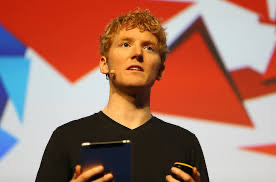
The man behind it is Patrick Collison, a 37-year-old from a village in rural Ireland who wrote his first program at ten. He built the company with his younger brother John, and their story is one of the cleanest arcs in modern tech — from a farmhouse in County Tipperary to the center of global commerce.
A Boy From Dromineer Who Coded Before He Could Drive
Patrick Collison was born on September 9, 1988, in Dromineer, a village of a few hundred people on the shores of Lough Derg in County Tipperary, Ireland. His mother Lily was a microbiologist. His father Denis was an electronic engineer. Neither worked in tech, but they gave their sons room to be obsessive.
Patrick took his first computer course at the University of Limerick at eight. By ten, he was programming. By 16, he had won Ireland’s Young Scientist and Technology Exhibition — the country’s most prestigious science competition — for a project involving a new dialect of the programming language Lisp.
The prize wasn’t just a trophy. It was an early signal that Patrick saw computers differently. Not as tools, but as raw material for building systems that didn’t exist yet.
Millionaires at 19 and 17: The Auctomatic Sale
In 2007, Patrick and his younger brother John — then 17 and 15 — started a company called Shuppa, which managed eBay listings for power sellers. They merged with two Oxford graduates, Harjeet and Kulveer Taggar, and renamed the venture Auctomatic.
The company caught attention fast. On Good Friday 2008, Canadian firm Live Current Media acquired Auctomatic for $5 million. Patrick was 19. John was 17. They were millionaires before either had finished university.
”We didn’t set out to sell a company. We set out to solve a problem for eBay sellers. But the experience taught us what building a real product looked like — and what the internet still couldn’t do well.”
Patrick enrolled at MIT. John went to Harvard. Both would drop out within a year.
The Frustration That Built a $159 Billion Company
What pulled the Collisons out of university was a simple observation: accepting payments online in 2009 was absurdly difficult. Developers had to register merchant accounts, negotiate with banks, integrate clunky APIs, and wait weeks for approval. The checkout experience was broken, and nobody seemed interested in fixing it.
The brothers started building what they initially called /dev/payments — a developer-first payments API that could be integrated in minutes. They joined Y Combinator’s summer 2009 batch, and by 2010 they had a working product: seven lines of code that any developer could paste into a website to start accepting payments immediately.
That was the insight. Not a better payment processor — a simpler one. Stripe launched in beta in 2011 and processed its first real transaction. The internet’s plumbing had found its plumber.
PayPal’s Founders Bet Against Their Own Legacy
Stripe’s first major fundraise was a $2 million seed round in 2011 — led by Peter Thiel and joined by Elon Musk, both co-founders of PayPal. Sequoia Capital and Andreessen Horowitz also participated. The irony was hard to miss: the people who built PayPal were funding a company designed to make PayPal’s developer experience obsolete.
The bet paid off. Stripe raised $18 million in a Series A, then $80 million at a $1.75 billion valuation in 2014. By 2016, the Collison brothers were the world’s youngest self-made billionaires — Patrick at 27, John at 25 — after a round from CapitalG and General Catalyst valued Stripe at $9.2 billion.
”We think of Stripe as building economic infrastructure for the internet. It sounds abstract, but the more we remove friction from online commerce, the more businesses get created.”
From Startup Darling to Global Financial Infrastructure
Stripe’s trajectory after 2016 was relentless. The company expanded from payments into billing, fraud prevention, corporate cards, treasury management, and financial reporting. Stripe Atlas let anyone in the world incorporate a U.S. company in days. Stripe Connect powered marketplace payments for platforms like Lyft and Instacart.
By 2021, a $600 million round valued Stripe at $95 billion — the highest private valuation in Silicon Valley history at the time. Then came the correction: a 2022 internal repricing cut the valuation to $50 billion as tech multiples collapsed. But revenue kept growing, and Stripe never needed to go public to survive.
In February 2025, a tender offer pegged the value at $91.5 billion. Twelve months later, that number jumped to $159 billion. Total payment volume hit $1.9 trillion in 2025, and Stripe’s revenue suite is on track for $1 billion in annual run rate this year.
The First Quarter of the Singularity — and What Stripe Does Next
Patrick Collison is not slowing down. In a recent interview, he called Q1 2026 a potential inflection point: “There’s at least a reasonable chance that 2026 Q1 will be looked back upon as the first quarter of the singularity.” AI companies — including vibe-coding unicorns like Lovable — are now one of Stripe’s fastest-growing customer segments. The company has also moved aggressively into stablecoin payments, noting that global stablecoin volume doubled to $400 billion in 2025.
”If you’re just substitution-oriented — not improving the product — I think you will suffer at the hands of somebody who is using AI to improve the product.”
Outside Stripe, Collison co-founded Fast Grants with economist Tyler Cowen to accelerate COVID-19 research funding, and launched the Arc Institute in 2021, a nonprofit tackling the bureaucratic bottleneck in biomedical research. He reads more books in a month than most people read in a year, maintains a personal website cataloging his intellectual interests, and still writes code.
There is no IPO on the horizon. Collison has said repeatedly that Stripe will go public “when it makes sense” — and not a day sooner. For now, the company he started with seven lines of code and his teenage brother processes more money than most countries’ GDP. The village of Dromineer has never produced anything quite like it.