
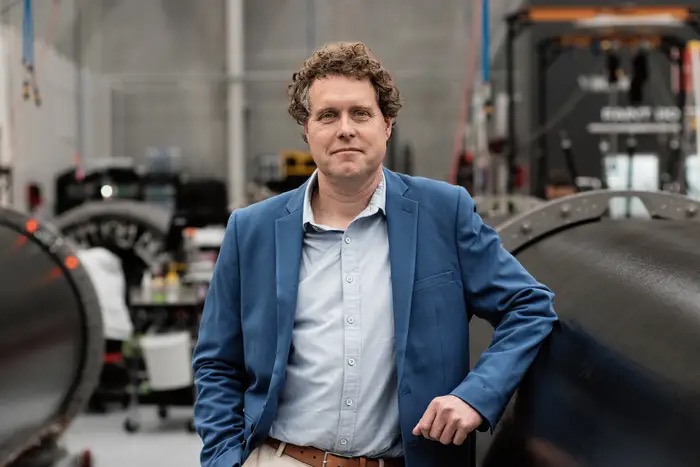
- Rocket Lab has completed 79 Electron launches, achieved $600 million in annual revenue in 2025, and trades on Nasdaq at a $38 billion market cap.
- Sir Peter Beck grew up in Invercargill, New Zealand, never attended university, and taught himself rocket engineering as a teenager.
- Beck founded Rocket Lab in 2006, made it the first private company in the Southern Hemisphere to reach space, and took it public via SPAC in 2021.
- The company’s next-generation Neutron rocket is set for its maiden flight in 2026, powered by the in-house Archimedes engine with 1.5 million pounds of thrust.
A $38 Billion Rocket Company Led by a Man Without a Degree
Rocket Lab sits at the center of the global space economy in 2026. With 79 orbital launches completed, a record $600 million in annual revenue, and a $1.1 billion contract backlog, the Long Beach-based aerospace company is the most credible alternative to SpaceX in the Western launch market. Its stock trades on Nasdaq under RKLB at roughly $72 a share, valuing the company at over $38 billion.
The man who built it never set foot in a university lecture hall. Sir Peter Beck, 49, founded Rocket Lab in 2006 from New Zealand — a country with no space industry, no launch infrastructure, and no reason to believe a self-taught engineer from the bottom of the South Island could compete with billion-dollar American defense contractors. He did it anyway.
A Teenager in Invercargill Building Rockets in His Parents’ Garage
Beck grew up in Invercargill, New Zealand’s southernmost city — closer to Antarctica than to most of the world’s space agencies. His father, Russell, was a museum director and gemologist. His mother was a teacher. Nothing about the environment screamed aerospace.
But Beck was obsessed. As a teenager, he turbo-charged an old Mini, launched homemade water rockets, and began experimenting with propulsion systems using whatever materials he could find. He read everything about rocketry he could get his hands on. There was no mentor, no program, no curriculum. Just a kid with a garage and an appetite for combustion.
”I have a raging cauldron of hell and conflict in my head because I’m half entrepreneur who wants to take extreme risk, and then half engineer who by nature is extremely conservative.” — Peter Beck
An Apprentice at Fisher & Paykel Who Built a Rocket Bike
In 1995, Beck took an apprenticeship as a tool-and-die maker at Fisher & Paykel, the New Zealand appliance manufacturer. He never enrolled in university. Instead, he used the company’s workshop after hours to build things that had nothing to do with dishwashers — a rocket-powered bicycle, a jet pack, a rocket scooter.
He moved on to Industrial Research Limited in 2001, where he spent five years working on superconductors, composites, and smart materials. The work was legitimate engineering — but Beck’s mind was somewhere else entirely. He was designing rocket engines on his own time, running propellant tests, iterating on thrust chamber designs. By 2006, a trip to the United States introduced him to a community of space enthusiasts who confirmed what he already believed: the launch industry was ripe for disruption.
2006: Founding Rocket Lab With No Money and No Industry
Beck founded Rocket Lab in Auckland in 2006. New Zealand had no orbital launch capability, no supply chain, and no regulatory framework for private spaceflight. None of that mattered.
Three years later, in November 2009, Rocket Lab launched Atea-1 — making it the first private company in the Southern Hemisphere to reach space. The suborbital sounding rocket proved the concept. Beck wasn’t dreaming anymore. He was launching.
”Just do what you said you were going to do and execute.” — Peter Beck
The company raised early funding from Khosla Ventures and Bessemer Venture Partners, then started building what would become its flagship vehicle: the Electron rocket, a small-lift launcher designed to carry payloads up to 300 kilograms to orbit. Its Rutherford engines were the first electric-pump-fed engines to power an orbital rocket — a technical bet that the rest of the industry considered impractical until Beck proved otherwise.
Electron: 79 Launches and the Busiest Small Rocket on Earth
Electron’s first orbital launch came in 2018. By the end of 2025, Rocket Lab had completed 79 missions — 21 in 2025 alone, every single one a success. The rocket became the workhorse of the small satellite market, flying payloads for NASA, the U.S. Department of Defense, commercial constellation operators, and international space agencies.
Beck built Rocket Lab into more than a launch company. The firm manufactures its own spacecraft, reaction wheels, star trackers, solar panels, and separation systems. It operates its own launch complexes — one on the Mahia Peninsula in New Zealand, and a second at Wallops Island in Virginia. Vertical integration at this level is something only SpaceX matches.
In August 2021, Rocket Lab went public on Nasdaq via a SPAC merger at an initial valuation of roughly $4 billion. The stock had a rocky first year, dropping as low as $3.50 in 2022. But by early 2026, it had climbed past $70 — a tenfold increase driven by Electron’s launch cadence, a growing space systems division, and investor confidence in what comes next.
Neutron: 1.5 Million Pounds of Thrust and a 2026 Debut
That next chapter is Neutron — a partially reusable, medium-lift rocket designed to carry 13,000 kilograms to low-Earth orbit. Powered by nine Archimedes engines generating a combined 1.5 million pounds of thrust, Neutron puts Rocket Lab in direct competition with SpaceX’s Falcon 9 for the most lucrative contracts in the industry — including the kind of missions that PLD Space in Europe and Vast’s space station program will eventually need: mega-constellation deployments and national security missions.
The Archimedes engines have been testing at NASA’s Stennis Space Center around the clock — 20 hours a day, seven days a week. The vehicle’s distinctive “Hungry Hippo” fairing system has completed qualification testing. The maiden flight is targeted for mid-2026 from Launch Complex 3 at Wallops Island. Rocket Lab has already signed its first multi-launch Neutron customer and secured a $24 million Space Force contract for upper-stage development.
”The thing that motivates me the most is having impact. Some people have this burning desire to go into space. I just have a burning desire to create things to enable others to go to space.” — Peter Beck
What Comes After Neutron: Venus, Hypersonics, and No Signs of Slowing Down
As Elon Musk expands into chip manufacturing with Terafab, Beck is charting a parallel path in space infrastructure. Beck was knighted in 2024 — appointed Knight Companion of the New Zealand Order of Merit for services to aerospace, business, and education. He is a billionaire. But the roadmap suggests a man who is nowhere near finished.
Rocket Lab is developing hypersonic test vehicles through its HASTE suborbital program, with three missions completed in 2025. Beck has spoken publicly about a private mission to Venus to search for signs of life in the planet’s atmosphere. And with Neutron entering the launch market, the company’s $1.1 billion backlog is likely just the beginning.
The distance from Invercargill to orbit is roughly 400 kilometers. The distance from a teenager building rockets in a garage to the CEO of a $38 billion aerospace company is something else entirely — and Peter Beck covered it without a single university lecture along the way.