
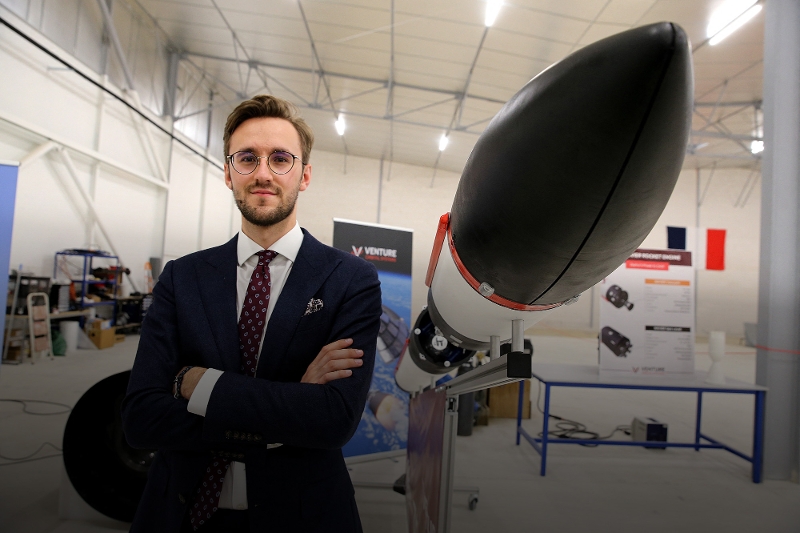
- Latitude is a French rocket startup building Zephyr, a 20-meter launcher designed to send 100-200 kg satellites into low Earth orbit from Kourou, French Guiana.
- Stanislas Maximin dropped out of business school at 20 with no engineering degree, no network, and no industry experience to found the company in 2019.
- Latitude is investing €50 million in a new 25,000 m² production facility in Reims and plans to hire 160 additional employees.
- Selected by Emmanuel Macron’s France 2030 program in 2024, Latitude targets 50 commercial launches per year by 2030 with a break-even point at just nine.
In September 2025, Stanislas Maximin stood on the launchpad at Kourou, French Guiana, and laid the first stone of the Ensemble Multi-Lanceurs — a brand-new facility that will let private companies send small satellites into orbit from European soil. His company, Latitude, now employs over 170 people, has signed contracts with satellite operators on three continents, and is building a rocket factory the size of four football fields.
He is 26 years old. He has no engineering degree. And five years ago, he had nothing.
A Rocket Company With 170 Engineers and a €50 Million Factory
Latitude builds Zephyr, a 20-meter-tall launcher purpose-built for the small satellite market. While legacy rockets keep getting bigger — and competitors like Peter Beck’s Rocket Lab dominate the American small-sat market — the satellites they carry have been shrinking for fifteen years. Zephyr fills a gap that barely existed a decade ago: dedicated rides for payloads between 50 and 200 kilograms into low Earth orbit.
The company’s client list already reads like a who’s who of the New Space economy. Spire Global, one of the largest satellite operators on the planet, is a customer. So are TRL Space in the Czech Republic and M3 Systems in Belgium. Latitude has also signed a 20-flight contract for in-orbit experimentation — a deal that alone could sustain years of operations.
A Stage at Disney, a Bus to Cape Canaveral, and a Life Decision
Maximin grew up dreaming about space. Not vaguely — specifically. He wanted to build rockets from the age of 14. But his academic path pointed nowhere near a launchpad. He enrolled at IESEG School of Management, a French business school, and spent a year and a half questioning why he was there.
The turning point came during an internship at Disney in Orlando, Florida. One weekend, he and a group of friends rented a bus to Cape Canaveral to watch a Delta IV Heavy lift off — one of the most powerful rockets flying at the time.
”It clicked. I saw the launch and told myself: this is what I want to do. Not watch it. Build it.” — Stanislas Maximin
He flew back to France with a Bac ES — the equivalent of a high school diploma in economics — and nothing else. No engineering credentials. No industry contacts. No capital. He was 20.
2019: A Company Built on Stubbornness and Zero Connections
In early 2019, Maximin registered Venture Orbital Systems — the company that would later become Latitude. The first eighteen months were brutal. He had no credibility in an industry where PhDs and decades of aerospace experience are table stakes.
Fundraising was nearly impossible. Investors didn’t return calls. The few who listened didn’t believe a 20-year-old dropout could build orbital-class hardware. The space sector is littered with startups that promise the moon and deliver PowerPoint slides. Maximin looked, on paper, like another one.
”We were considerably unprepared when we started. It lasted at least a year and a half. We didn’t know anyone. It took a lot of trial and error — and a stroke of luck.” — Stanislas Maximin
That stroke of luck was Reims. The team relocated to the Champagne capital and found their first investor locally, right as COVID-19 froze the rest of the economy. With no employees yet, the pandemic barely touched them. They kept building.
From 10 People in 2020 to 170 in 2025 — And Every Mistake in Between
Growth came fast and messy. Latitude went from a handful of people in 2020 to over 170 by 2025. Maximin is candid about the cost of that speed. Early hires didn’t always have the right experience. Processes broke. The company had to learn aerospace-grade rigor on the fly.
But the technical philosophy Maximin set from day one held the ship together: no technological bias. Latitude doesn’t chase exotic propulsion breakthroughs or unproven materials. When they adopted 3D printing for Zephyr’s turbopump — one of the most critical components in any rocket — it was because the geometry made traditional manufacturing impossible, not because it sounded innovative.
“Keep it simple and stupid” is the internal motto. In an industry addicted to complexity, Latitude bets on pragmatism.
Macron’s Bet: €400 Million on France’s New Space Champions
In March 2024, President Emmanuel Macron personally unveiled four startups selected to rebuild France’s sovereign launch capability under the France 2030 program. Latitude was one of them. The French government committed €400 million in contracts to small launcher companies — a direct acknowledgment that Europe’s space dominance, once unquestioned with Ariane, had slipped away.
Latitude secured a contract with CNES, the French space agency, for Zephyr’s inaugural flight from Kourou — the same spaceport that PLD Space’s MIURA 5 will launch from later this year. The company was also selected for Bpifrance’s “Première Usine” program, unlocking support for its new production site — a former AstraZeneca laboratory in Reims that will be converted into a 25,000 m² rocket factory. Total investment: €50 million. Target output: 50 launchers per year.
Europe’s Three-Year Window to Stay in the Space Race
Maximin doesn’t sugarcoat the stakes. Europe was the global leader in space launch 25 years ago. It is not anymore. The United States, led by SpaceX, has recaptured the most lucrative European contracts. China is accelerating. And Europe’s institutional programs — large, slow, expensive — keep losing ground to American startups that move faster with less capital.
“The next three years will decide whether Europe stays a space power or not,” Maximin told Bpifrance’s Big Media. He argues that without competitive, dual-use launch services — commercial and military — Europe will forfeit its sovereignty in orbit. Latitude’s break-even sits at just nine launches per year. Once there, Maximin plans to expand into larger, cheaper rockets to challenge the incumbents head-on.
Fifty Launches a Year by 2030
Latitude’s next milestone is Zephyr’s first flight from Kourou. After that, the cadence is supposed to ramp fast — from a handful of missions to 50 annual launches by 2030. The new Reims factory will employ 160 additional workers to meet that pace. The observation-of-Earth market, where clients deploy constellations of 40 to 100 satellites, is the core revenue driver.
Maximin’s advice to anyone thinking about starting a company in deep tech is disarmingly simple: resilience matters more than credentials. He had no degree, no network, and no particular work ethic advantage. What he had was a dream that made him do what others told him was impossible — and an ecosystem that, despite everything, eventually let him prove it.