
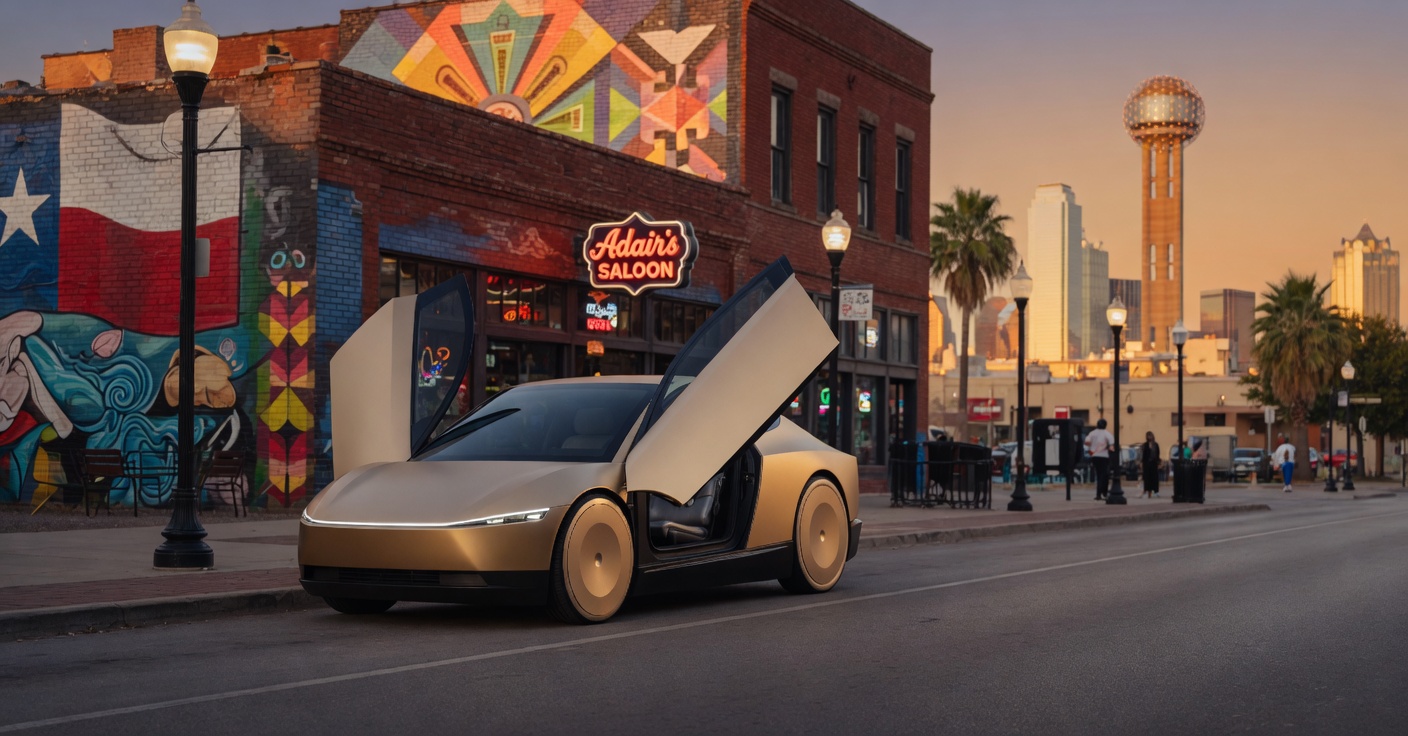
- Tesla robotaxi rolls out in Dallas and Houston, the first new cities since Austin’s 2025 launch.
- Only one driverless Tesla logged in each city versus 46 active vehicles tracked in Austin.
- Morgan Stanley keeps a $415 price target, calls the rollout “tangible progress” on FSD.
- Ross Gerber dismisses the timing as cover for a weak Q1 2026 earnings report on Wednesday.
- Waymo already runs unsupervised service in Dallas, Houston, and eight other US cities.
- Ford CEO Jim Farley says BYD, not Tesla, is now the real EV benchmark to beat.
Tesla Robotaxi Expansion 2026: Dallas and Houston Join the Austin Fleet
Tesla announced Saturday that its driverless robotaxi service is now live in parts of Dallas and Houston, the first new metros added since the Robotaxi account opened Austin in mid-2025. A 14-second clip posted by the company showed vehicles moving through traffic with no human in the front seat. Elon Musk reposted it with “Try Tesla Robotaxi in Dallas & Houston.”
The Tesla robotaxi expansion 2026 remains very thin on the ground. Crowdsourced data from the Robotaxi Tracker site shows only one active vehicle in each new city, against 46 logged in Austin. Tesla’s February filing disclosed 14 crashes involving Austin robotaxis since launch — a number investors will revisit alongside Wednesday’s Q1 2026 earnings report.
Morgan Stanley vs Ross Gerber: Wall Street Splits on Tesla FSD Progress
Morgan Stanley’s Andrew Percoco called the Dallas and Houston rollout “tangible progress at a time when the market was growing increasingly skeptical” and kept his $415 price target. He framed the move from supervised Austin rides to unsupervised deployment as a “material evolution” that could “create a powerful flywheel” across Tesla’s auto sales, margins, and ecosystem.
Ross Gerber of Gerber Kawasaki sees the opposite. He dismissed the launch as a strategy to “kick the can down the road” before earnings, per Benzinga, and has demanded $10,000 refunds if Full Self-Driving version 14.3 fails to reach unsupervised capability. Tesla is also fighting more than 21 active lawsuits, including wrongful-death claims tied to FSD with potential billion-dollar exposure.
Waymo vs Tesla Robotaxi: Who’s Winning the Driverless Race in 2026
Waymo has quietly built the lead investors used to assume Tesla had locked in. Google’s robotaxi arm now runs fully unsupervised service in 10 US cities — including Dallas and Houston — and opened Miami and Orlando to all riders last week after an invite-only phase. Autonomous testing has reached London, while Tesla still runs only a handful of unsupervised cars in a slice of Austin.
Early passenger reports underline how raw Tesla’s system still is. A Dallas rider told Business Insider his Tesla robotaxi missed a highway exit, began slowing as if to pull over as cars passed at 80–90 mph, circled a hotel five times, and dropped him 2.6 miles from his destination — an 11-mile, 54-minute ride that cost $18 versus $16 for a three-mile Waymo trip in the same city.
Tesla Q1 2026 Earnings: BYD Competition, FSD Lawsuits, and Margin Pressure
Ford CEO Jim Farley this week told analysts Tesla “really doesn’t have an updated vehicle” and named BYD, not Tesla, as Ford’s competitive reference for the next wave of EVs. Farley believes US buyers now want $30,000 pickups and SUVs, not the $50,000 range Tesla defends. Tesla delivered 358,023 units globally in Q1 while BYD posted 310,389 pure-electric sales — the narrowest gap yet.
Tesla still sold 117,300 EVs in the US in Q1, more than every other EV brand combined, and the Model Y led Chinese retail in March with 39,827 registrations. But with TSLA stock at $400.62 against a 498.83 buy point, Musk needs Wednesday’s call to translate the robotaxi expansion into a credible path on FSD, margins, and China throughput — or Gerber’s “kick the can” read becomes the consensus.
Tesla Robotaxi | Tesla | Waymo | Benzinga