
- Anthropic is valued at $380 billion after closing a $30 billion Series G in February 2026 — the second-largest venture deal of all time.
- Dario Amodei holds a PhD in biophysics from Princeton and helped build GPT-2 and GPT-3 as VP of Research at OpenAI.
- His net worth has climbed to an estimated $7 billion, nearly doubling in six months.
- Anthropic’s annualized revenue reached $19 billion in March 2026, with Claude Code alone generating $2.5 billion.
A $380 Billion Company Built on the Promise of Restraint
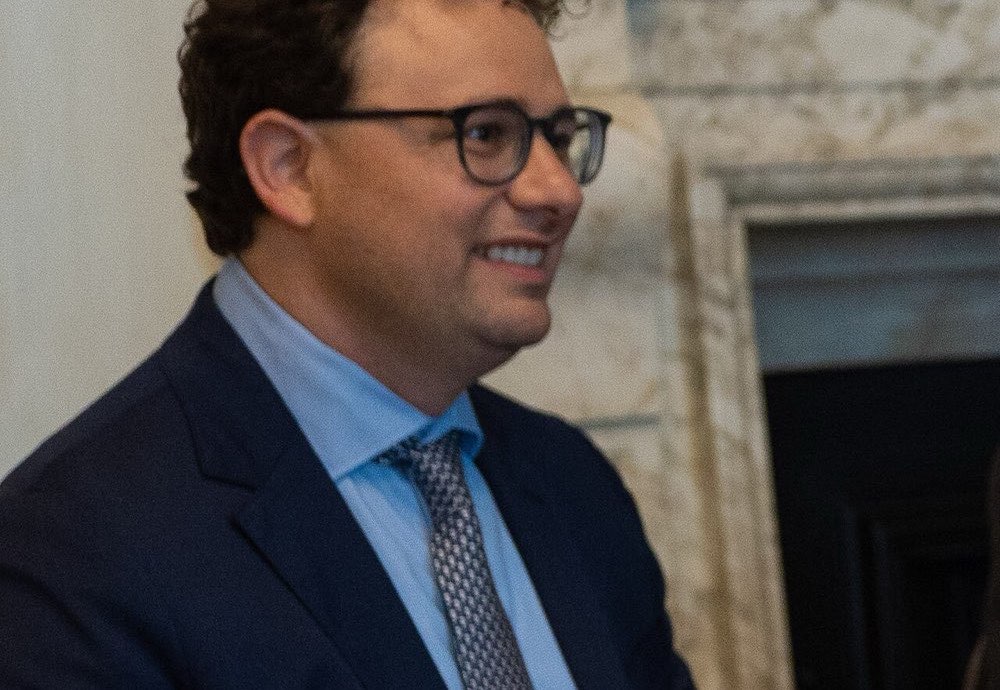
Anthropic sits at the center of the AI arms race — and insists it doesn’t want to be there. The San Francisco-based company has raised nearly $64 billion since its 2021 founding, employs over 1,000 people, and operates Claude, one of the most widely used AI assistants on the planet. Its CEO, Dario Amodei, is a 42-year-old physicist-turned-entrepreneur who built his career on a single conviction: the most powerful technology in human history needs guardrails before it needs growth.
That conviction made him a billionaire. It also made him one of the most polarizing figures in Silicon Valley — a man who warns about existential risk while raising tens of billions to build the very systems he says could be dangerous.
A Science Kid in San Francisco’s Mission District
Dario Amodei was born in 1983 in San Francisco to Riccardo Amodei, an Italian leather craftsman, and Elena Engel, a Jewish-American project manager. He grew up in the Mission District, a neighborhood defined more by taquerias than tech. His sister Daniela, who would later become Anthropic’s president, was born four years later.
Math came first. Physics came second. Everything else came distant third. Amodei was the kind of kid who preferred equations to conversation, who found comfort in the objectivity of numbers. He enrolled at Caltech to study physics, then transferred to Stanford, where he earned a bachelor of science degree in 2006. A PhD in biophysics at Princeton followed, focused on electrophysiology — mapping how neural circuits fire and communicate.
”I was always interested in the question of how the brain works. Not philosophically — mechanistically. What are the actual computations happening inside neurons?”
He completed a postdoctoral fellowship at Stanford Medical School. The academic path was clear. He chose to abandon it.
From Baidu to Google Brain: Learning to Scale Intelligence
In 2014, Andrew Ng was building a superteam at Baidu with a $100 million budget to push AI forward. He recruited Amodei. The work was transformative: Amodei contributed to Deep Speech 2, a speech recognition system named one of MIT Technology Review’s top 10 breakthroughs of 2016. More importantly, the experience crystallized his understanding of scaling laws — the principle that bigger models, trained on more data with more compute, produce predictably better results.
He moved to Google Brain in 2015 as a Senior Research Scientist, co-authoring influential papers on AI safety and deep learning reliability. But corporate research had its limits. Amodei wanted to build, not publish. When OpenAI came calling in 2016, he answered.
The Break with OpenAI That Changed the AI Industry
At OpenAI, Amodei rose to Vice President of Research. He led the teams that built GPT-2 and GPT-3 — the models that proved language AI could scale to genuinely useful levels. He was directly involved in the commercialization of GPT-3. This was not a man opposed to building powerful AI. He was opposed to building it carelessly.
By early 2021, the tension had become unbearable. Amodei saw a growing gap between capability development and safety practices at OpenAI. He tried to shift priorities from within. It didn’t work.
”It is incredibly unproductive to try and argue with someone else’s vision. Take some people you trust and go make your vision happen.”
In January 2021, Amodei left OpenAI. He took six colleagues with him, including his sister Daniela. They founded Anthropic with a radical premise: build the most capable AI systems in the world, but make safety the engineering priority rather than an afterthought. The company launched as a public benefit corporation — a legal structure that binds it to social impact alongside profit.
From Garage-Stage Startup to $14 Billion in Revenue
Anthropic’s first year was quiet. The team published research on Constitutional AI, a technique that trains models to self-correct based on a set of principles rather than human feedback alone. Investors took notice. Google invested $300 million in early 2023. Amazon followed with a commitment that would eventually total $8 billion.
Then came Claude. Launched in March 2023, Anthropic’s AI assistant carved out a distinct identity: longer context windows, stronger reasoning, fewer hallucinations. By early 2026, Claude had dethroned ChatGPT as the most downloaded AI app in the US. By 2024, Claude had become the preferred tool for developers, researchers, and enterprises that needed reliability over flash. Revenue exploded from near zero in 2023 to $1 billion in annualized run-rate by early 2025, then $10 billion by year’s end.
Claude Code, the company’s AI coding agent, hit $1 billion in annualized revenue by November 2025 — faster than ChatGPT, faster than any enterprise software product in history. Its rise helped fuel the broader AI coding boom that pushed Cursor past $2 billion in annualized revenue.
$64 Billion Raised, a $380 Billion Valuation, and Seven Billionaire Co-Founders
The funding rounds tell the story of acceleration. A $450 million Series C in May 2023. A $2 billion Series D led by Google in October 2023. A $7.3 billion Series E in early 2025. A $13 billion Series F in September 2025 at a $183 billion valuation. Then the staggering $30 billion Series G in February 2026, led by GIC and Coatue, valuing the company at $380 billion.
All seven co-founders are now billionaires. Amodei’s personal stake is worth an estimated $7 billion. The company’s annualized revenue reached $19 billion in March 2026, with business subscriptions quadrupling since January. An IPO is expected later this year — Anthropic has engaged Wilson Sonsini to begin preparations, according to the Financial Times.
The Physicist Who Writes 15,000-Word Essays About the Future
Amodei governs Anthropic with the same rigor he brought to neural circuit research. He publishes long-form essays that read more like academic papers than CEO thought pieces. “Machines of Loving Grace” laid out a vision where AI compresses 100 years of medical progress into a decade. “The Adolescence of Technology” argued that humanity is in an awkward growth phase with its most powerful tools — capable enough to cause harm, too immature to fully understand the consequences.
He predicts AGI within one to three years, with 90% confidence by 2035. He tells engineers at Anthropic that some of them no longer write code — Claude does it all. He believes AI will generate trillions of dollars in revenue before 2030.
”I think it’s crazy to say that this won’t happen by 2035. The question is whether we’ll be ready for it.”
Dario Amodei built his former employer’s most important models, walked away from them, and created a competitor now valued higher than Goldman Sachs. The physicist who mapped neural circuits in a Princeton lab now maps the future of intelligence itself. Whether Anthropic’s safety-first bet holds as the race intensifies is the $380 billion question.