
- AI coding agents like Claude Code are making it cheaper to build software than to buy it, undermining the core SaaS value proposition.
- The per-seat pricing model is breaking down as AI agents replace the human users those seats were designed for.
- A February investor sell-off wiped nearly $1 trillion in market value from software and services stocks.
- Venture-backed SaaS IPOs have effectively frozen, with no listings expected in the near term.
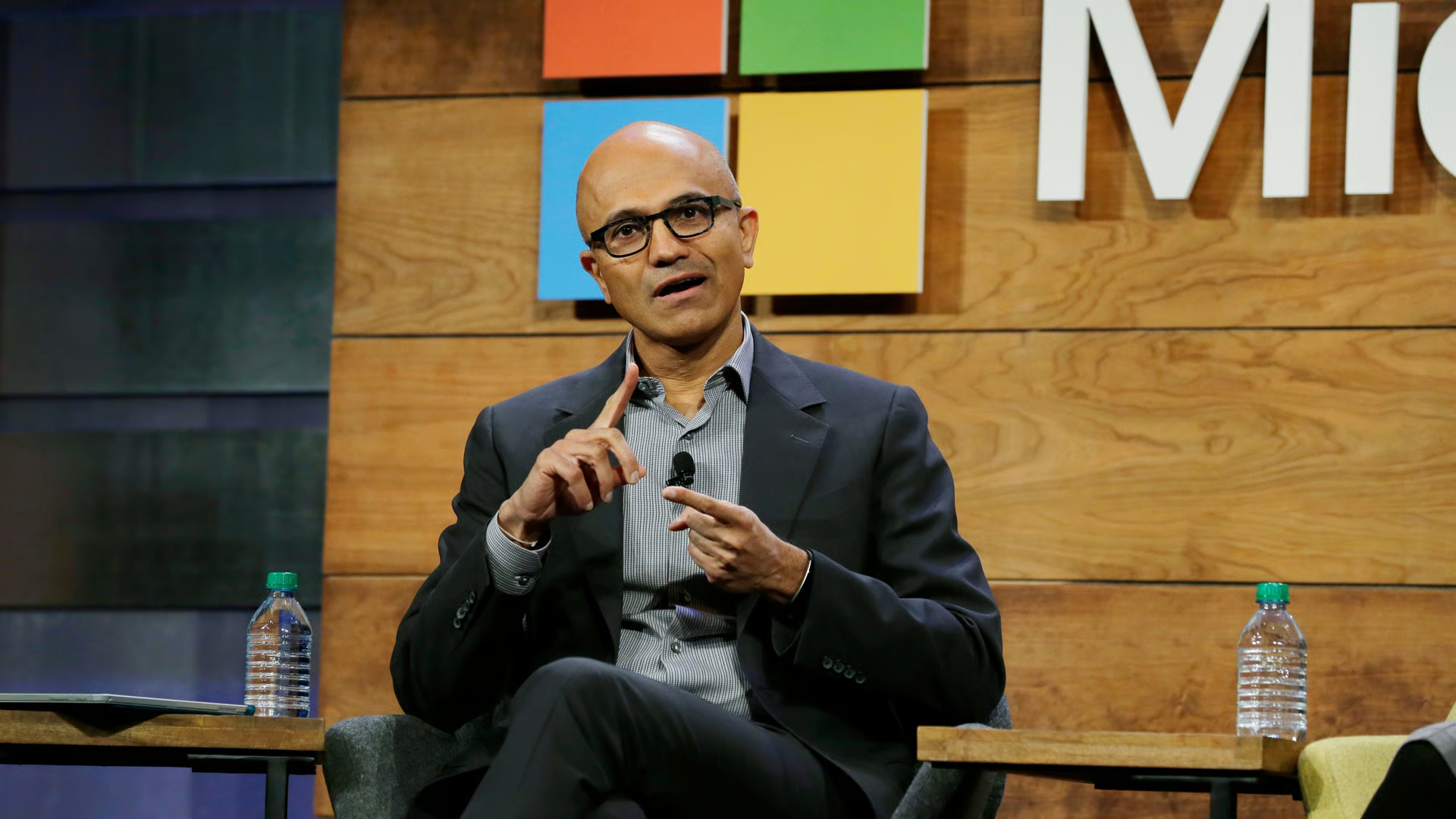
- Microsoft CEO Satya Nadella predicts AI agents will replace traditional SaaS applications entirely within two years.
The Build vs. Buy Equation Has Flipped
Not long ago, a founder texted his investor with an update: he was replacing his entire customer service team with Claude Code, an AI tool that can write and deploy software on its own — and one that has already overtaken ChatGPT in US App Store downloads. To Lex Zhao, an investor at One Way Ventures, the message signaled something bigger — the moment when companies like Salesforce stopped being the automatic default. “The barriers to entry for creating software are so low now thanks to coding agents, that the build versus buy decision is shifting toward build in so many cases,” Zhao told TechCrunch.
The shift goes beyond just building tools in-house. The SaaS per-seat pricing model is under existential attack. SaaS companies have long charged per seat — by how many employees log in to use the product. When one AI agent can pull the data, run the analysis, and file the report, that per-seat model starts to collapse. Customers now have the ultimate contract negotiation tool: if they don’t like a vendor’s prices, they can build their own alternative faster and cheaper than ever before. The question of whether AI will replace the workers who used those SaaS tools is no longer hypothetical. “Even if they do not take the build route, this creates downward pressure on contracts that SaaS vendors can secure during renewals,” said Abdul Abdirahman, an investor at the venture firm F-Prime.
We saw this as early as late 2024, when Klarna announced it had ditched Salesforce’s flagship CRM in favor of its own homegrown AI system. The realization that a growing number of companies can do the same is now spooking public markets.
The SaaSpocalypse Hits Wall Street
The public market carnage has been swift and brutal. In early February, an investor sell-off wiped nearly $1 trillion in market value from software and services stocks, followed by another wave later in the month. Analysts are calling it the SaaSpocalypse, with one dubbing it FOBO investing — fear of becoming obsolete.
The pattern is best illustrated through Anthropic’s recent product launches. The company released Claude Code for cybersecurity, and related stocks dropped. It released legal tools in Claude Cowork AI, and the iShares Expanded Tech-Software Sector ETF — a basket of publicly traded software companies including firms like LegalZoom and RELX — also dropped. Every time a new advanced AI tool launches, SaaS stocks feel a tremor. “This may be the first time in history that the terminal value of software is being fundamentally questioned, materially reshaping how SaaS companies are underwritten going forward,” Abdirahman said.
Microsoft CEO Satya Nadella has gone further, predicting the outright end of SaaS as we know it. According to Nadella, what we call software today is essentially just a fancy interface sitting on top of databases, performing basic CRUD operations. The future he envisions is not about better software — it is about no software at all. Instead of traditional applications, AI agents will interact directly with databases and systems, replacing complex user interfaces with natural language. 84% of people have never used AI. The other 16% are already building the tools that will make the old guard irrelevant — though early data suggests AI apps monetize fast but struggle to retain users, adding another layer of uncertainty to the transition.
SaaS IPOs Are Frozen
Public-market SaaS companies are not the only ones feeling the chill. A Crunchbase report released this week showed that, though the IPO market seems to be thawing for some sectors, there have not been — and are not expected to be — any venture-backed SaaS IPOs in the near term. Large, private, late-stage SaaS companies like Canva and Rippling face intense pressure given a persnickety IPO window, sky-high expectations driven by AI advancements, and the unsteady stock prices of already public SaaS companies.
Some of these companies, including mid-size SaaS players, have even struggled to raise extension rounds in the private market over the same fears public investors have. “Nobody wants to be subjected to the volatility of public markets when sentiment can send companies into downward tailspins,” said Yoni Rechtman, a partner at Slow Ventures, adding he expects companies like these to stay private for much longer. Meanwhile, the public market waits to see the financials of the first AI-native companies hoping to IPO — the scuttlebutt says both OpenAI and Anthropic are contemplating listings, possibly later this year.
What Comes After SaaS
The most likely outcome is not death, but metamorphosis. AI-native startups are rising at a record pace, having completely redefined what it means to be a software company. Cursor crossed $2 billion in annualized revenue in March, and Lovable hit $400 million ARR with just 146 employees — growth curves that would have been unthinkable for traditional SaaS companies at the same stage. Former Salesforce CEO Bret Taylor’s AI startup Sierra — competing in the same enterprise infrastructure space where WorkOS just raised $100 million — — a quasi-Salesforce competitor offering customer service agents with outcome-based pricing — hit $100 million in annual recurring revenue in less than two years. New business models are emerging around consumption-based pricing, where customers pay based on how much AI they actually use, and outcome-based pricing, where fees are tied to results.
But venture investors argue the panic is overblown. “This isn’t the death of SaaS,” said Aaron Holiday, a managing partner at 645 Ventures. “It’s the beginning of an old snake shedding its skin.” Holiday said enterprises will always need software that meets compliance regulations, supports audits, manages workflows, and offers durability. “Durable shareholder value isn’t built on hype. It’s built on fundamentals, retention, margins, real budgets, and defensibility.” The SaaSpocalypse calls to mind what happens when someone new lights up the room — but the room itself is not going anywhere. The most important thing to understand, Abdirahman said, is that “it is simultaneously a real structural shift and potentially a market overreaction.” Investors, as always, sell first and ask questions later.